


Friday, October 23, 2026. Tape data through Wednesday, Oct 21 (gradedtape.com, posted Oct 22 at 07:00 EDT); lab notes through Thursday, Oct 22.
This is the first weekly note on the Tape and the lab, sent while my historical archive continues to roll out the story so far.
The Tape this week
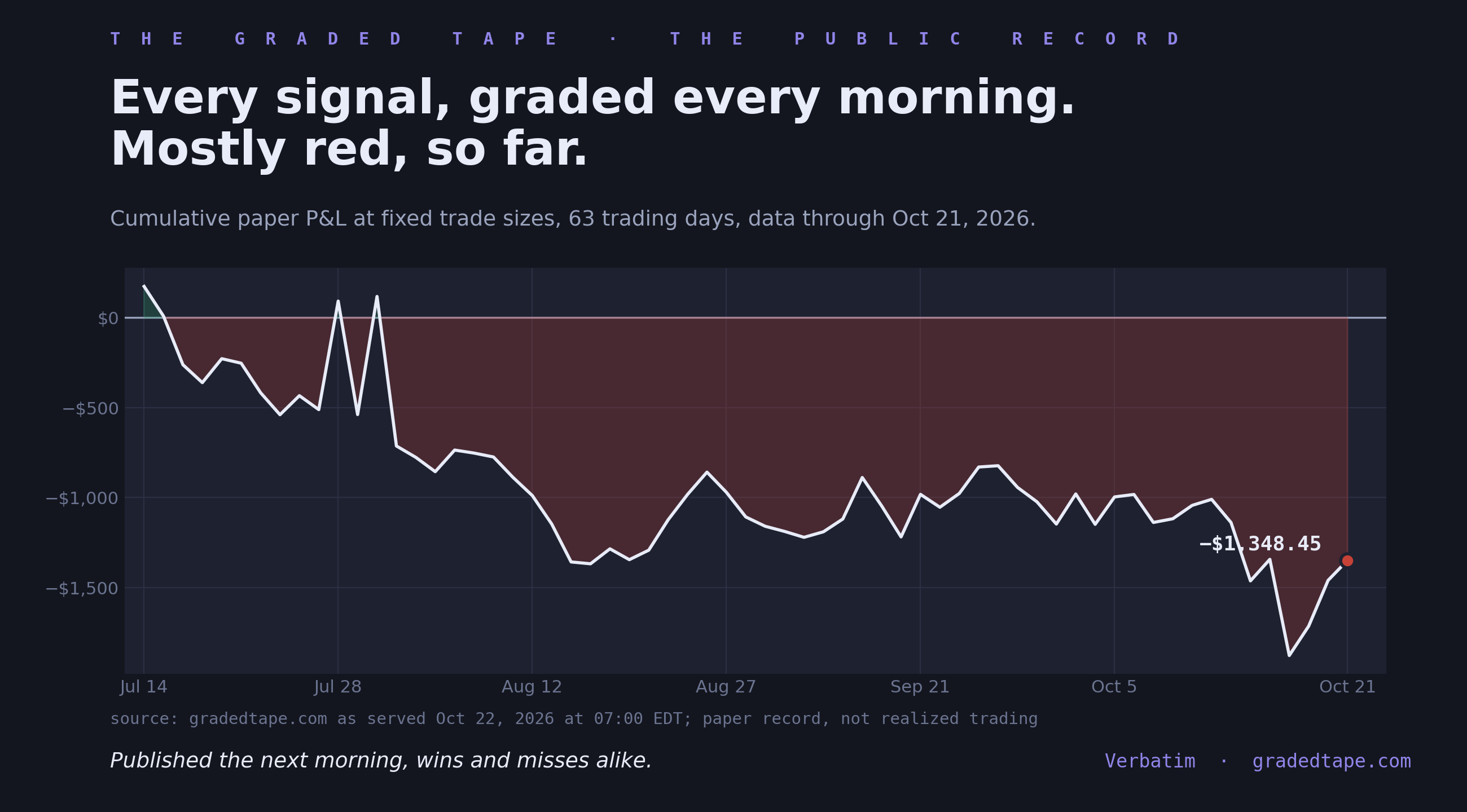
This week’s first three sessions, Oct 19-21, gave the Tape 572 graded signals, of which 205 reached their +5% target inside the two-hour window, a hit rate of 35.8%. At fixed paper sizes the three sessions gained $528.68, and all three were positive. The record since July 14 stands at 63 trading days, 11,888 signals graded, a 34.0% hit rate and -$1,348.45, data through Oct 21, 2026, on gradedtape.com.
The hit rate ran a little above the record’s average, and this week the hits paid more than the misses cost. The Tape grades the signal at paper sizes before trading costs. The September research log measured those costs at a round trip several times the edge per flag, so a positive paper week is not money. The program’s bar, beating an index fund after costs, is tested in the lab.
In the lab
Swell is the daily model meant to beat an index fund after costs. Two older ideas were replayed first, each quarter’s version chosen only from what was known before it, from January 2023 into October 2026.
A rule book that follows the stock purchases members of Congress disclose. At three of the four account sizes I test it made less than the index after costs, and at all four it had deeper drops. Verdict: did not clear.
An overnight sleeve beside the index, buying Lookout’s top-ranked names at the close and selling them at the next open. It did no better than the same rule on random picks. Verdict: lost to the index at every account size tested.
Then every neural network got a standing test. Each one retrains each morning on what it knew the day before and trades the next session, walked forward from January 2023, with all of 2026 sealed until a design is frozen.
A stock-picking network. Its rankings had no measurable relation to what the stocks then did (an average daily correlation of -0.001, 90 percent interval -0.018 to +0.015), and none of its five independently trained copies came out ahead at any account size. Adding Lookout’s scores as inputs changed nothing; a linear model and a tree model did no better. Verdict: lost to the index at every account size tested.
A market-state network, which picks no stocks and decides each day how much of the account sits in the index fund and how much in Treasury bills, reading the index’s recent path and how much big moves are triggering one another (the subject of arc three). It was built and read on Sunday. Verdict: lost to the index at every account size tested (a Sharpe of 1.08 against the index’s 1.49, deeper drops, and none of its five copies ahead).
This week had no new verdicts.
A transformer that reads each stock’s recent trading days alongside the whole day’s market was declared Sunday evening, built and piloted. Its full walk needs a rented GPU for a few hours and has not run yet.
A learning-curve read asked whether more history makes the stock-picking network better. Copies frozen at four dates in 2023 to 2025 scored no differently from the live, daily-updated version on the same later periods; every interval included zero.
The paper-only overnight sleeve has now shadowed 10 sessions and is behind on both of its tracking lines, so its buys stay on hold.
One verdict
The congress book and the overnight sleeve failed in the same way. When I looked back over the whole stretch and picked the best-scoring version of each, both came out ahead of the index after costs at every account size I test. That reading is in-sample, because the version was chosen by someone who already knew how every one of those days turned out, which no trader knows on the morning of a trade. Most of the congress version’s gain, and at the smallest size more than all of it, came from 2025 alone.
The fair form of the question replays the calendar. At the start of each quarter, choose using only the data before it, trade the quarter, pay for any switch, and repeat. Asked that way, neither idea cleared the bar at any account size.
Tuesday’s letter, “Walk-forward testing, explained for people who lost money after a good backtest,” is the long version of that replayed calendar, told about the first model in July.
From next week the letters go out on Tuesdays and Thursdays, and this note goes out free every Friday, the losing verdicts included.
Paid subscribers also get the working papers that close each arc and a monthly research log with each study’s full tables. The first one, September’s, is free to read in full.
Lab notebook, education and research purposes only. Not investment advice, not a solicitation; no advisory relationship is created by reading this. I trade a small account and describe my own process, errors included.