


This is a lab notebook kept by one retail trader who builds custom neural networks to find short-horizon stock opportunities. Every verdict is published, including the ideas that fail.
If you have spent any time around trading newsletters, you already know the gimmicks of the genre. A confident voice + a chart with lots of green and arrows pointing up + a historical track record that begins when the good streak did, and a sense that the author has never once been wrong.
I have read a bunch of these, and in my earlier trading years I subscribed fervently. One day, it clicked with me that none of them could be validated from the outside, by the audience.
So, I stopped subscribing and decided to build, instead.
Verbatim tries the opposite of these stereotypical newsletters. Every claim here comes out of a process built to stop me from fooling myself that I’m good at trading, and I run that process in public, where you can check it.
How it works
Before any idea gets a verdict (or any of my cash), I write down my hypothesis, the exact success bar it must clear, and what the test will cost. Scientists call this pre-registration. It exists because anyone allowed to peek at the answer first will reliably find whatever they were hoping to find - aka, they fooled themselves.
I’d rather keep my bar consistent, and high.
Two things have to happen before a win counts. The experiment has to clear a minimum effect size, and its confidence interval has to sit clear of zero.
I build that interval by resampling the test results with a fixed random seed, so even the interval is reproducible.
When an idea fails, I publish it here with the same detail as a success, with the numbers and confidence intervals attached.
When something breaks, which happens all the time, I’ll post about it too.
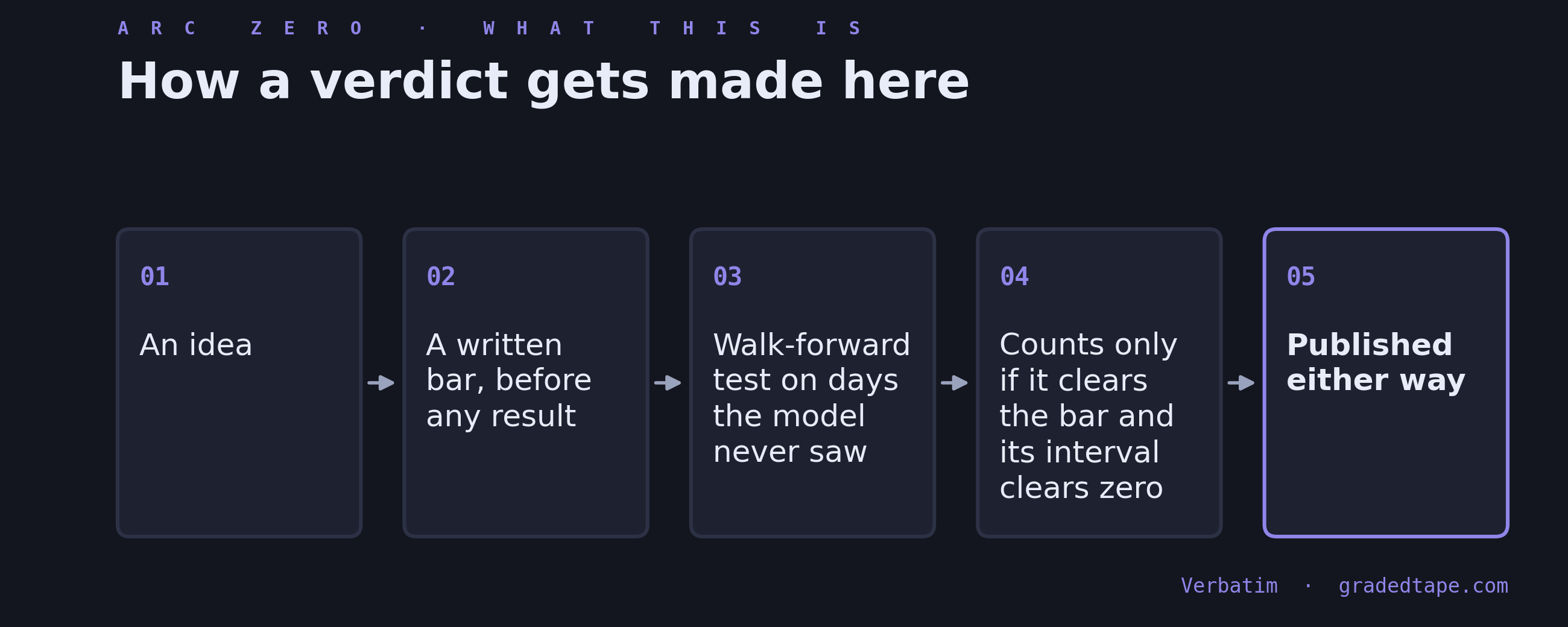
Approach
I pretty much follow the scientific method:
Become curious about an idea
Design an experiment to explore it
Ask the hardest question at a reasonably solvable bar
Run the cheapest test that I can afford* to prove myself wrong
*Note: I’ll never compete in HFT with the big guys, and I don’t think I need to in order to make money.
I don’t do speculative work. I’m definitely hands-on, and the first thing I built is “Lookout”, an intraday neural network and autonomous trading system described in this first batch of letters. It paper trades daily under set rules, and every fill gets recorded against what was expected.
The gap between backtest and reality is itself an interesting thing to measure (and now publish). So far, the edge has not survived in execution, but you’ll see exactly how that goes along the way.
Who this is for
You will probably enjoy this letter if you are:
a retail trader who has noticed how rarely anything sold to retail traders comes with verifiable evidence
a programmer or data person who has wondered what would happen if someone applied real experimental discipline to markets at a small scale
someone building with AI coding tools who wants to see how far one person can take them
a quantitatively curious investor who wants to see how the sausage is made
someone who enjoys watching a person argue with his own optimism in public, using statistics and deep learning
There are no picks here, just the process and its results, misses included.
Disclaimers:
Yes, I’m building multiple models and an app that I’ll release only if it’s worthwhile
Training the Lookout neural network ensemble cost me real money, itemized down to the dollar in the first arc. The training happened before Verbatim launched. I had to prove to myself I could post something interesting.
What you get
I’ll share regularly, in arcs, and each arc is a complete story.
The first arc covers a research campaign in which I spent $423 of rented supercomputer (H100) time trying to prove my own model wrong in nine different ways.
Spoiler, I mostly succeeded. Learn from me so you spend less money.
Later arcs cover the machinery of not fooling yourself, some strange physics that describes how market moves cluster, and what happened when the signals met real trading costs, which is where the program turned.
Paid subscriptions fund the lab behind Verbatim, and every verdict stays free either way.
There’s also a founding tier, four hundred dollars a year, for anyone who wants to fund the lab harder. Your rate locks for as long as you subscribe, and founding subscribers get first claim on anything that opens later, if and when a model passes its sealed test.
Posts arrive a few times a week while the archive builds. Down the road, the tools this program runs on, the dashboards and daily model outputs I use myself, may become available to subscribers.
The fine print
Everything published here exists for education and research purposes. It is not investment advice, not a recommendation to buy or sell any security, and not a solicitation of anything. I am not an investment adviser, and nothing here creates an advisory relationship. I write about my own small account and my own process, I will be wrong regularly and in writing, and any tools that eventually accompany this letter will be research tools, offered to study a process. Remember that markets take money from people, every day, and nothing in this notebook changes that.
If that appeals to you, welcome. The first arc starts with a scoreboard. Nine ideas, one rule, $423. Most of the answers were “no,” but eventually the Lookout neural network ensemble survived. Its signals are graded by a machine every morning and published on The Graded Tape, which stays a paper record at stated sizes, with every signal that could be entered under its rules, misses included.
Those signals have not made live money yet. The Tape is mostly red, a pre-registered test of trading them through the day lost money in October 2026 (its main configuration even before costs), and the program has turned toward a second model being built to beat the index after costs. These letters run on a delay and each one is dated, so read the Tape for where things stand today. I’m looking forward to showing you the whole climb, the parts that failed included.
Lab notebook, education and research purposes only. Not investment advice, not a solicitation; no advisory relationship is created by reading this. I trade a small account and describe my own process, errors included.