


Before my first real post, I want to share my operating rules where everyone can see them.
What I publish
Verdicts, either way. Every verdict appears with its success bar, written down before the test ran, its cost, and its result, whether the result is good or bad.
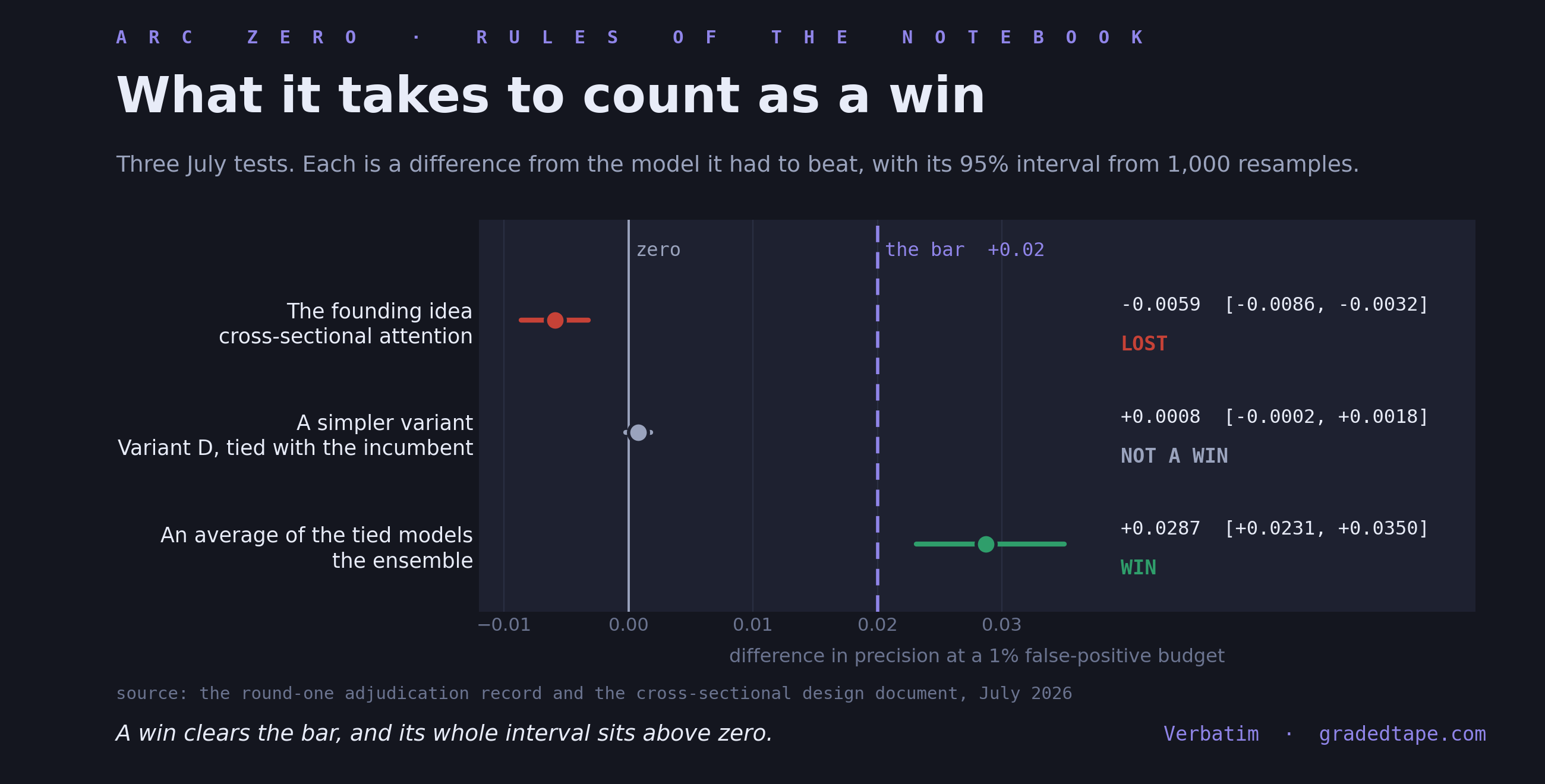
Confidence intervals, always. When I say a model improved by +0.029, I will show you the range the improvement lives in, so you can see whether the claim clears the noise or got lucky. The range comes from a paired bootstrap: resample the per-window score differences a thousand times, with a fixed random seed so the interval itself is reproducible, and read off the middle 95 percent. A claim has to survive a thousand alternate versions of its own test period before it appears here as a win.
Real costs in real dollars. GPU rentals, data, the price of finding things out. Account performance appears in percentages; the account is small and its size is not the interesting part.
Incidents. When the pipeline breaks, when I mess up my own data with a careless command, when fifteen days go missing from a dataset, you get the forensic report. The failures are where I learn the most.
Fills. Every completed round trip on the paper simulator is logged against what the model expected, and once live trading begins, real fills get the same treatment. The gap between paper and practice (traders call it slippage) is a number that almost never gets published. I’m going to publish mine, to be part of the solution and all that.
Rules first, receipts forever on The Graded Tape. Subscribe to Verbatim and hold me to every one of them as the program heads for the live market.
What stays private, for now
The Lookout model’s exact inputs, thresholds, and screens. Any edge I find is what pays for the lab, so those stay private. When something stays private, I’ll openly share why, instead of writing around it.
The rules the program itself runs under
Each of these will get its own post in time:
Every verdict is decided by a bar written down before the test runs, with a budget.
All scoring is walk-forward: a model trains only on data that existed before each test window, is graded on the unseen days that follow, and then the window rolls ahead and the exercise repeats through the years. No verdict rests on a question the model had already seen answered.
Every model has to outrun boring baselines tested on the same windows.
A slice of recent history stays sealed until one scheduled final reading.
Ties go to the simpler method, and new ideas carry the burden of proof.
No result counts as evidence until the process that produced it can be replayed from scratch.
None of this is exotic; it’s roughly what any decent research lab does. I just do it on a small trading account, in public.
Where we are headed
The arcs ahead, roughly in order:
The campaign. Nine of my best ideas meet the rules, and the rules win.
The machinery. The checks that keep the experiments honest: walk-forward testing, a sealed quarter of data, the pre-registration template, and a failure published on purpose.
The physics. Big market moves cluster like earthquake aftershocks, measurably, and the mathematics seismologists use for aftershocks describes them well. As a way to pick stocks it failed; it found its job sizing my positions instead, shrinking them when the market runs hot.
The turn. What happened when Lookout’s signals met real trading costs, and why the program re-aimed at a plainer goal: grow the account faster than an index fund would, after every cost.
The models after Lookout. Ballast, a portfolio allocator that decides what to hold and at what size, failed its own full-history test and now runs on paper as a check. Swell, a network that trains and trades once a day, is being put through its gates now, and has earned nothing yet.
The diary. Whatever earns its way there trades live and writes down what happened, every morning, indefinitely.
Somewhere along the way, the instruments this program runs on may become available to subscribers as research tools. As a reminder, this is a notebook for education and research, never advice. Hold me to all of it.
From arc two on, the working papers sit below the line for paid subscribers, twenty dollars a month or two hundred a year. The founding tier, four hundred a year, is for readers who want to fund the lab harder, with the rate locked and first claim on anything that opens later, if and when a model passes its sealed test.
Lab notebook, education and research purposes only. Not investment advice, not a solicitation; no advisory relationship is created by reading this. I trade a small account and describe my own process, errors included.