


Written in July 2026. Anything that has changed since then is marked with an October update.
Nine ideas and $423 produced exactly one clean win. The winner cost fifteen dollars, contained no new ideas, and took an afternoon.
How it works
Take the four statistically tied variants from the last post.
Add the plain logistic control as a fifth member.
Average their probability estimates.
Each day, for every name under consideration, all five emit a probability that the name is about to make its move, and the ensemble’s score is the plain average of the five, with nothing to tune. That average is what Lookout, my intraday neural network ensemble, runs on today (a sixth member has since been added under the same rules).
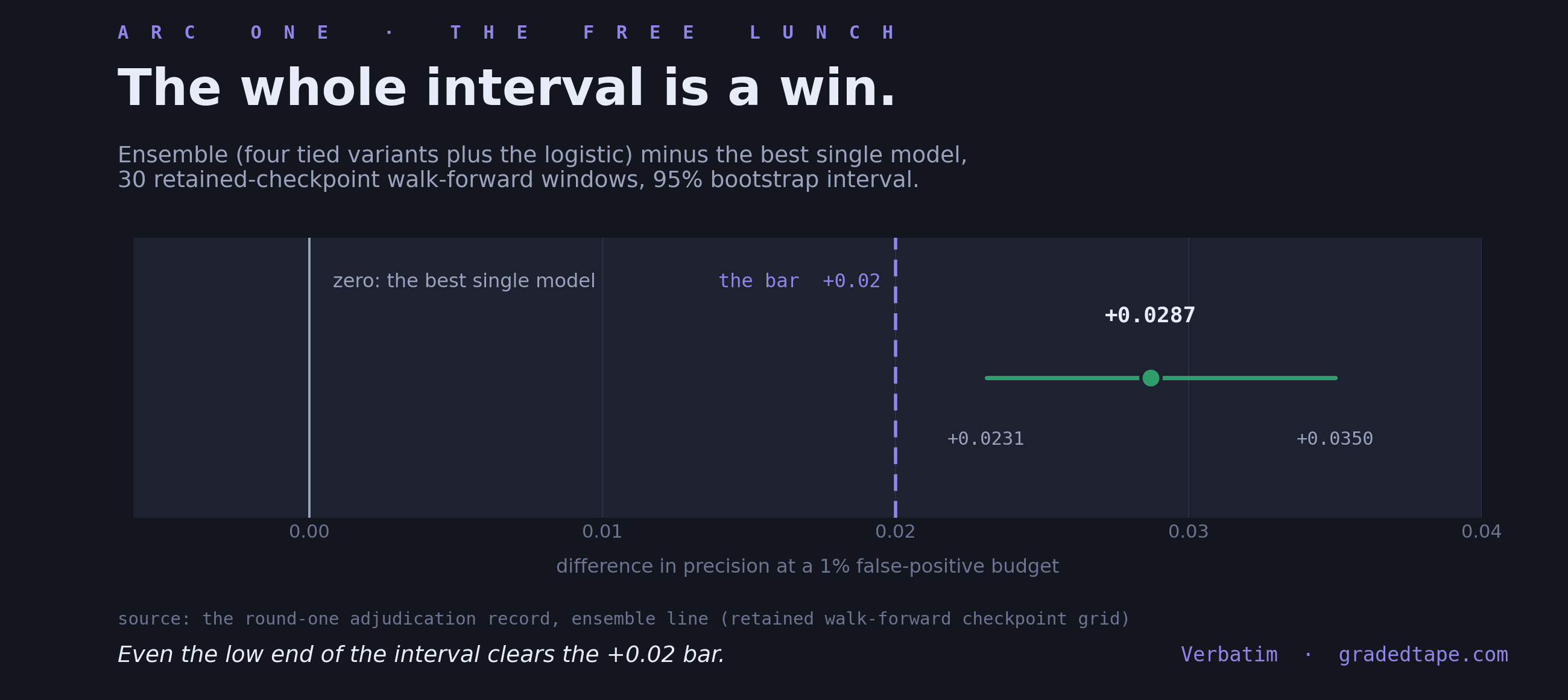
The clever ideas had to beat the incumbent by +0.02 with the confidence interval clear of zero, judged by the same paired bootstrap that settles everything in this notebook, and none of them did. The average only had to beat its best member with an interval clear of zero. It cleared the clever ideas’ bar too, with room to spare, at roughly an eight percent relative improvement on the precision score, or close to three more correct catches in every hundred flags.
Same average, different days
This came from looking at daily rankings instead of summary scores. The four variants land on the same average, but they look at different things, are built differently and trained under different constraints, so on any given day they disagree, sometimes sharply, about which names belong at the top of the list. When variant A is right and variant C is wrong, and the next day it flips, an average keeps the signal they share and lets most of the disagreement (mostly noise) cancel out.
The math is old: the shared signal survives averaging untouched, while errors cancel roughly in proportion to how independent they are. Models this close in skill and this different in construction are the ones worth averaging.
Why a weaker member helps
The odd member is the fifth one. Adding a logistic regression that scores visibly below the other four sounds like it should make the average worse, and at first I resisted it for that reason. It helps anyway, because its errors are the most different in kind: it fails where the deep variants don’t, and gets a few right where all four are wrong together. An average gains from mistakes that land in different places, which is why the weakest member still earns its seat. (Probably true of most committees, though people take the point better when it’s about models.)
What “free” means here
Free here means the production cost is computing a mean, with nothing new to train and no new data. It also has no settings, and settings are where I fool myself, because anything with settings tempts me to adjust them until the number looks better. Something free could fairly be held to a lower bar; this one cleared the full bar anyway, so adopting it was the easiest call of the campaign.
Cheap wins and expensive lessons both go on the record here. Subscribe and get the ledger as it grows.
If you train models
If you train models on market data and keep getting annoyingly similar scores from different configurations, you may already have the win. Those similar configurations are different, comparably skilled models, and their average is very likely better than the best of them.
That average went into production. It retrains every night on a small computer at home while I sleep, and its signals are the ones graded in public every morning on The Graded Tape, misses and all. Of everything in the program, it’s the part I understand best.
October update: the average still retrains every night, and The Graded Tape still grades its signals at fixed paper sizes. Through Oct 16, 2026 it reads -$1,877.13 over 60 trading days. Better ranking hasn’t turned into money yet.
Lab notebook, education and research purposes only. Not investment advice, not a solicitation; no advisory relationship is created by reading this. I trade a small account and describe my own process, errors included.
Free subscribers get the build notes below, covering the 200-line averager, the bug in its first run, and the habit that would have saved a later test.
How I built it
The averager trained nothing. It is about 200 lines and ran in roughly 45 minutes of GPU time, which is most of the fifteen dollars. During the long runs each variant saved a checkpoint every 25th window. The script reloaded those, scored 30 windows from before the held-back months, fit a fresh logistic on each window’s training days, and averaged the five probabilities. Averaging ranks instead gave the same answer to the third decimal.