


Written in July 2026. Anything that has changed since then is marked with an October update.
Last week I rented a datacenter GPU and spent several days using it to test nine ideas against my own trading model.
I trade a small account. A couple of years of discretionary trading taught me that the biggest risk in my account was me, believing a backtest because I wanted it to be true. So when I started building Lookout, my neural network ensemble for finding intraday opportunities, I adopted one rule before writing any code.
Every idea gets a written hypothesis, a success bar and a price tag, all committed before I’m allowed to see any results. Scientists call this pre-registration.
New letters arrive by email, free. Subscribe and the next one comes to you.
The setup
All through the trading day, Lookout ranks thousands of stocks by the probability that they’re about to make a large move within the next hour or so. I grade it with a deliberately harsh statistic. Among the names the model is most confident about, holding false positive rates to a budget of one percent (P@1%FPR), what fraction actually go on to make the move? Random guessing scores about 0.01 on this test, since large intraday moves are rare. My baseline model scores around 0.34 to 0.36, depending on the period. That gap is why I trusted it.
Then I tested it. Each of the nine ideas below tried either to beat that baseline or to show it wasn’t real, and each was written down first, with what was being tested, the bar it had to clear (for most, beat the incumbent by more than +0.02 on matched test windows, with a bootstrap confidence interval clear of zero), and what it would cost to find out.
The scoreboard
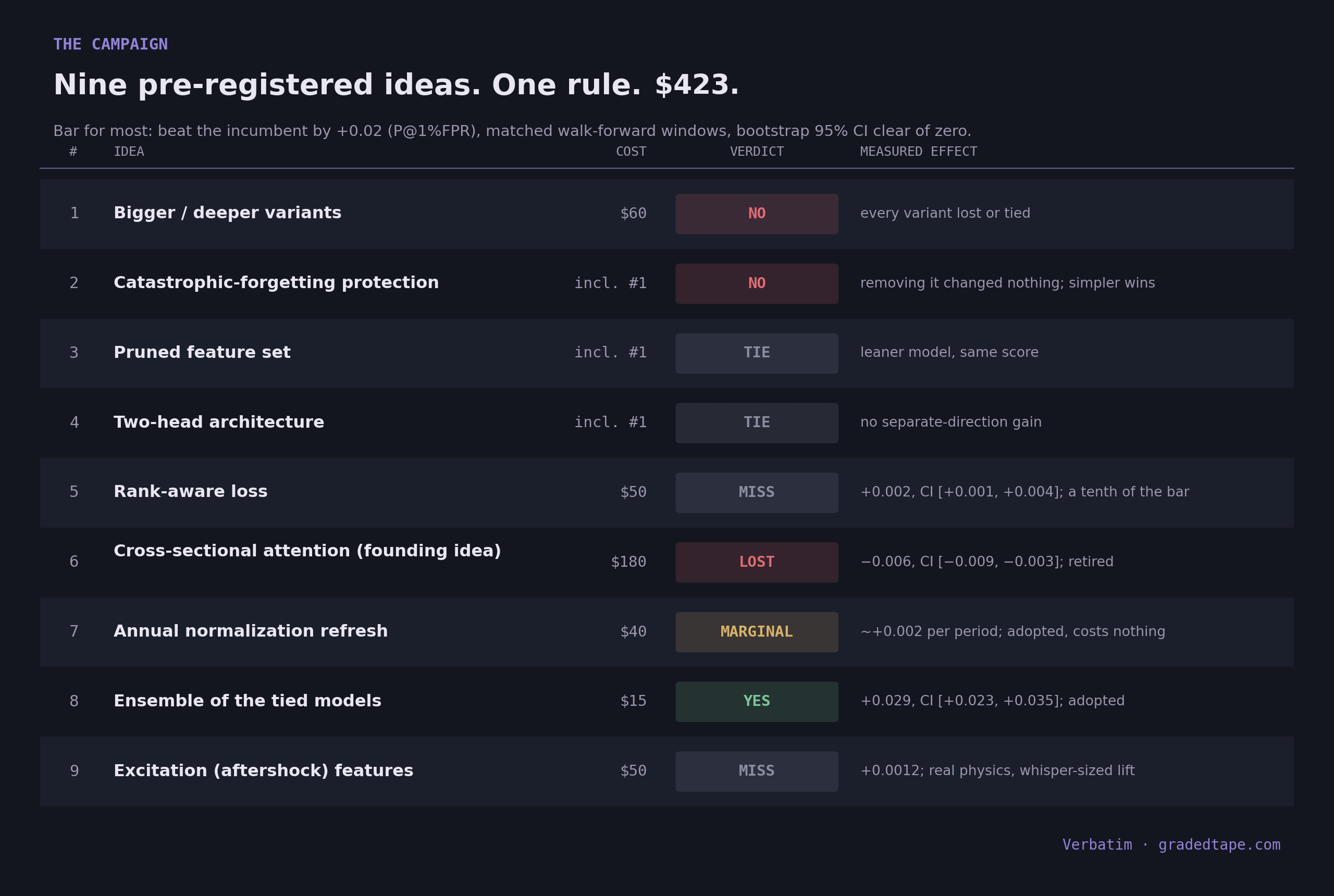
(The itemized rows sum to about $395; the rest of the $423 was shared machine time and failed runs that belong to no single question. Storage and platform subscription fees are not counted, since they carry the whole lab rather than this one campaign.)
That table is mostly no’s, with two ties, a couple of near-misses and one clean win. Each no kept me from trading an idea that didn’t work.
The lab publishes either way. Subscribe and watch the next campaign run.
What the no’s bought
The failed experiments were the valuable ones. Take row 6. That was my founding thesis, the belief this whole project was organized around, and it lost clearly on a matched comparison that was designed before the result existed.
I know what would have happened without the rule, because I’ve lived it. I would have tweaked and re-run, tweaked and re-run, and eventually “discovered” a configuration that beat the baseline by chance. Then I’d have put it into production and lost real money on it.
So the $423 mostly bought the knowledge that the model I already had was better than eight of my nine ideas, and that the ninth, a plain average of the four tied variants with a simple logistic regression added as a fifth member, was worth +0.029. That’s roughly an eight percent relative improvement, about three more correct calls in every hundred signals, and its production cost is computing a mean.
The rule that made it work
One number per idea, written down first. A bar the idea must clear, a confidence interval so a lucky result can’t clear the bar by chance, and a standing tie-break: when in doubt, the simpler and older thing wins.
(For the technically inclined, the interval comes from a paired bootstrap. I resample the per-window score differences a thousand times with a fixed seed and read off the middle 95 percent, so “beats the incumbent” has to survive a thousand alternate versions of the same test period before it counts.)
The rule decided every verdict in that table. I set every rule before the results exist, so there’s nothing to argue about when they arrive.
Where this goes
The campaign ended with a model I trust, because eight attempts to beat it failed under (what I think are) fair rules. Working out why the thesis lost showed where the model is most precise, which changed my watchlist. The aftershock measurement was too weak to pick stocks, so it went into my risk management instead. And the ensemble, the boring average, is what Lookout v1.0 runs on today (with a sixth member added since). It retrains itself every night while I sleep, and its signals are graded in public every morning on The Graded Tape, misses and all.
October update: the ensemble still retrains every night, and the Tape still grades its signals every morning. Its precision held up. It has not made money so far. Through Oct 16, 2026 the Tape reads -$1,877.13 at fixed paper sizes over 60 trading days.
In the next letter my founding thesis loses, and I share why I’m glad it did.
Lab notebook, education and research purposes only. Not investment advice, not a solicitation; no advisory relationship is created by reading this. I trade a small account and describe my own process, errors included.
For The Campaign arc, Free subscribers will continue to get access to the build notes below, covering the 122-line script that judged all nine questions, and how to check one like it by hand.
How I built it
The script that judged all nine questions is 122 lines of Python and needs nothing beyond the standard library. An agent wrote it in one sitting on the evening of the verdict.
It reads the file every training run writes, which holds one line of JSON per walk-forward window, with the dates, the settings, the code version and every score. Runs append as they go, so a crash costs one window and the run picks up from the last line.
The script does five things, in order: