


Like a lot of systematic traders, I started as a retail trader with a theory. I had several theories, one per season, and the (expensive and ugly) brokerage statements to show for it.
It took me a long time to see the pattern.
There was the stretch where I only took setups from a book whose author seemed trustworthy… on account of his expensive vest and collared shirt.
There was my momentum phase, which taught me that I could correctly identify momentum…shortly after it ended.
There was a long period of what I would have called instinct, which in retrospect was a disciplined process for buying things that had just finished going up.
None of this was overly risky. I traded small, which I’d love to credit to wisdom, though the account balance enforced it. But the lessons added up, and somewhere in there I noticed the common factor in every losing theory: the person holding it. My selective memory made me attribute the wins to anything except luck, and my backtests had a way of confirming whatever I had already decided.
Over the years, I learned more about good data science practice, and it eventually occurred to me that I would never accept from a junior data analyst the standard of evidence I routinely accepted from myself about trades. If an analyst told me a model was good, I would ask, “Good compared to what baseline, on what held-out data, decided by what threshold, chosen before or after you saw the results?” I had never once asked myself those questions with my own money on the line.
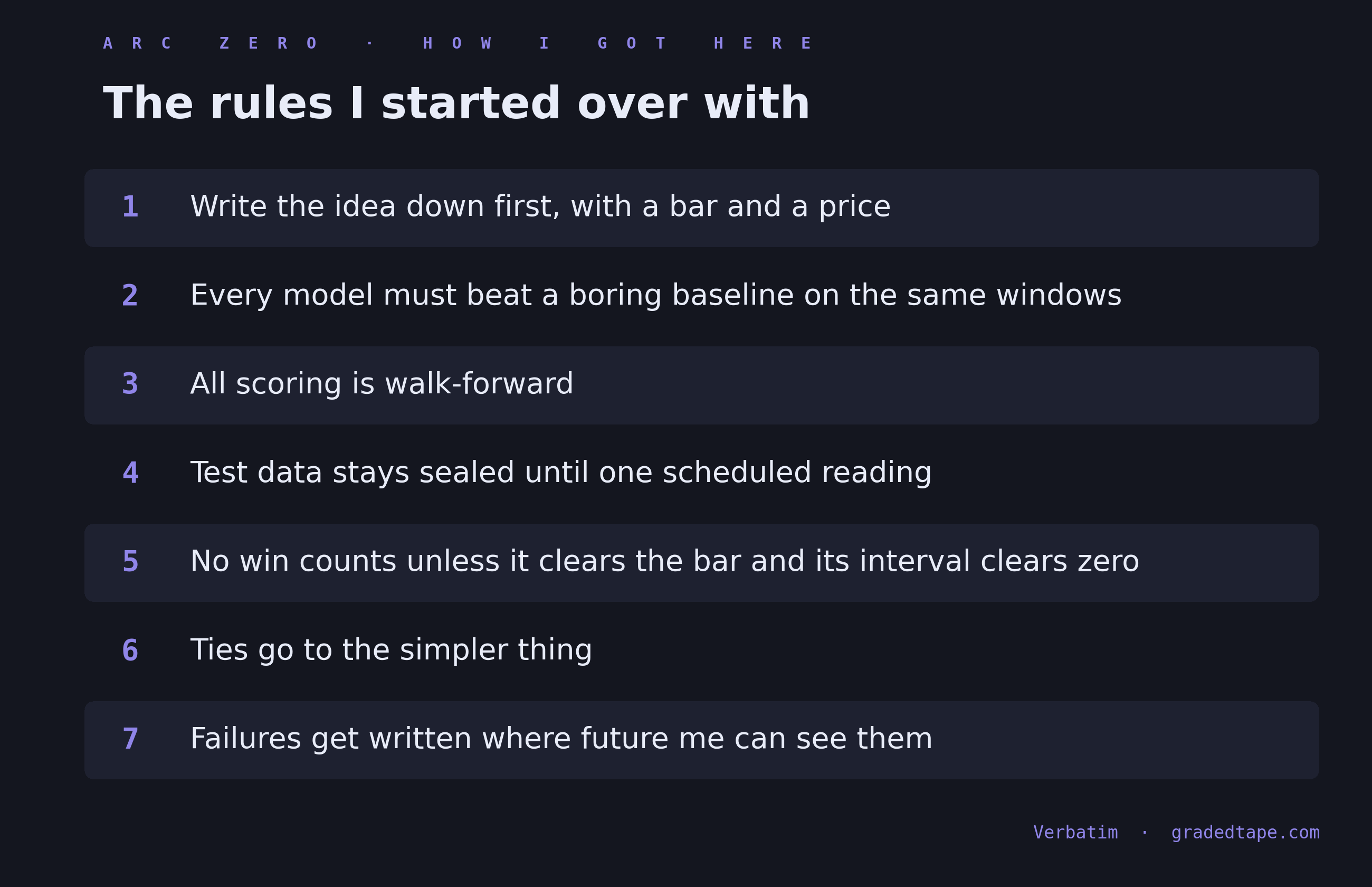
So I started over, with rules. Every idea written down before testing, with a bar it must clear and a price for finding out the answers.
“So what?” and “Compared to what?” and “Why did that work?” became my favorite questions.
Two of the rules got stricter than the rest:
All scoring would now be done “walk-forward,” meaning the model trains only on data from before each test window, gets graded on the unseen days that follow, and then the window rolls ahead and the whole exercise repeats, year after year, so no score ever comes from a question whose answer the model had already been shown.
I moved to testing against “held out” data that the process is forbidden to touch until a single, final, pre-scheduled reading. No improvement counts unless its confidence interval, built by resampling the results, sits clear of zero. Failures get recorded where future-me can see them, because future-me has a documented history of creative forgetting.
The surprise was how much of what I thought made my good trades didn’t survive the rules, and how quickly the process started producing things worth keeping anyway.
This letter is the running audit trail of those rules at work. Subscribe and get every entry, verdicts included.
The first arc is the campaign where nine of my best ideas met the rules and mostly lost. Lookout, the neural ensemble that came out of it, earned my trust as a forecaster long before it had a chance to earn a dollar, and it hasn’t earned one yet. After that come the machinery, some physics borrowed from earthquake research, and the live tape, where the trust gets tested in dollars.
Lab notebook, education and research purposes only. Not investment advice, not a solicitation; no advisory relationship is created by reading this. I trade a small account and describe my own process, errors included.