


I’m not an engineer. A single retail trader can run a lab like this because of AI coding tools, and I suspect some of you are here for that part at least as much as for the markets.
November 2022
It started in November 2022, with a brand new M1 iMac and the first public release of ChatGPT. I knew enough to be dangerous up to that point. Product development work and years of hobby projects left me comfortable with HTML, CSS and JavaScript, some Python and Java, and just enough Processing and Arduino to have some fun. What I had never done was build software the way engineers do. I had never opened VS Code, didn’t know what a virtual environment was, had never heard of a package manager, and had never made a git commit.
So my first workflow was an obvious one. I described what I wanted, copied the code ChatGPT gave me into a file, ran it, pasted the error back, and went around again…and again…and again…and again. It worked often enough to keep me going. I could see where generative AI was heading, and I rode the wave early.
The long apprenticeship
The next couple of years were an apprenticeship in everything around code and software engineering. I learned the software development lifecycle, serverless functions on AWS (and later on DigitalOcean), S3 storage, fetching data on a schedule, automations that sent me emails, data transformation, data science workflows, thesis writing, and the quant finance that all of it was supposed to serve. I started over many times. About two years ago I started over once more, this time with the rules from the second letter, and those rules still govern everything here.
By the first half of 2024 the project had real plumbing. I had bought API subscriptions to Polygon.io (now Massive) for market data, including its bulk flat files, and to QuiverQuant for alternative data, and I had fetchers pulling both automatically, with deploy and scheduling scripts for AWS Lambda and a plan to move to DigitalOcean and Paperspace.
The assistants of that era, ChatGPT first and then Cody from Sourcegraph, could only take in one file, or about a hundred lines, at a time. So I assembled context by hand. A few of those prompt files survive in the old project: a list of file names, a sentence reading “Today’s work will solely be related to the files... within this directory,” and ten rows of data pasted inline so the assistant could see what a table looked like.
In effect…I was the context window.
June 2025: the shift
By late 2024, I had moved my work into a dev container, a development environment defined in a configuration file so it can be rebuilt identically anywhere, running in GitHub Codespaces. In June 2025 I installed Claude Code, Anthropic’s command-line coding agent, and it changed how I worked. Cursor and Copilot had been around for a while, and I used both, but neither fit the way I worked across a whole codebase.
Instead of me feeding it a hundred lines at a time, the agent could read the whole project, run the code, see the error itself and try again.
In early July I finished its standing instructions file, and on July 20 the first commit landed with Claude listed as a co-author.
On July 26, 2025 I committed my first agent “team,” a set of personas the agent could step into. There was a data architect, a quant ML code reviewer, and personas for UX, product and monetization.
The next day’s commit message begins “ran out of tokens” and goes on, “Next time I startup claude, I may need a full review by the team.” Within a day I’d found out what it could do and what it cost. By August, most commits carried Claude as a co-author.
Rented and owned
By September 2025 I was renting H100s, the datacenter GPUs, by the hour on Paperspace; a commit that month recorded a 24x speedup from tuning for them. At the end of October a Mac mini joined my desk as an always-on home server, and the nightly automation moved onto it.
From November 2025 into February 2026 I stepped away.
In March 2026 I came back and split my one big repository into separate ones for the data fetchers, the feature pipeline and the model, dropped the DigitalOcean dependencies, and moved to self-hosting. Over the following weeks the fetchers got containers, data manifests and a nightly schedule.
The tall bar
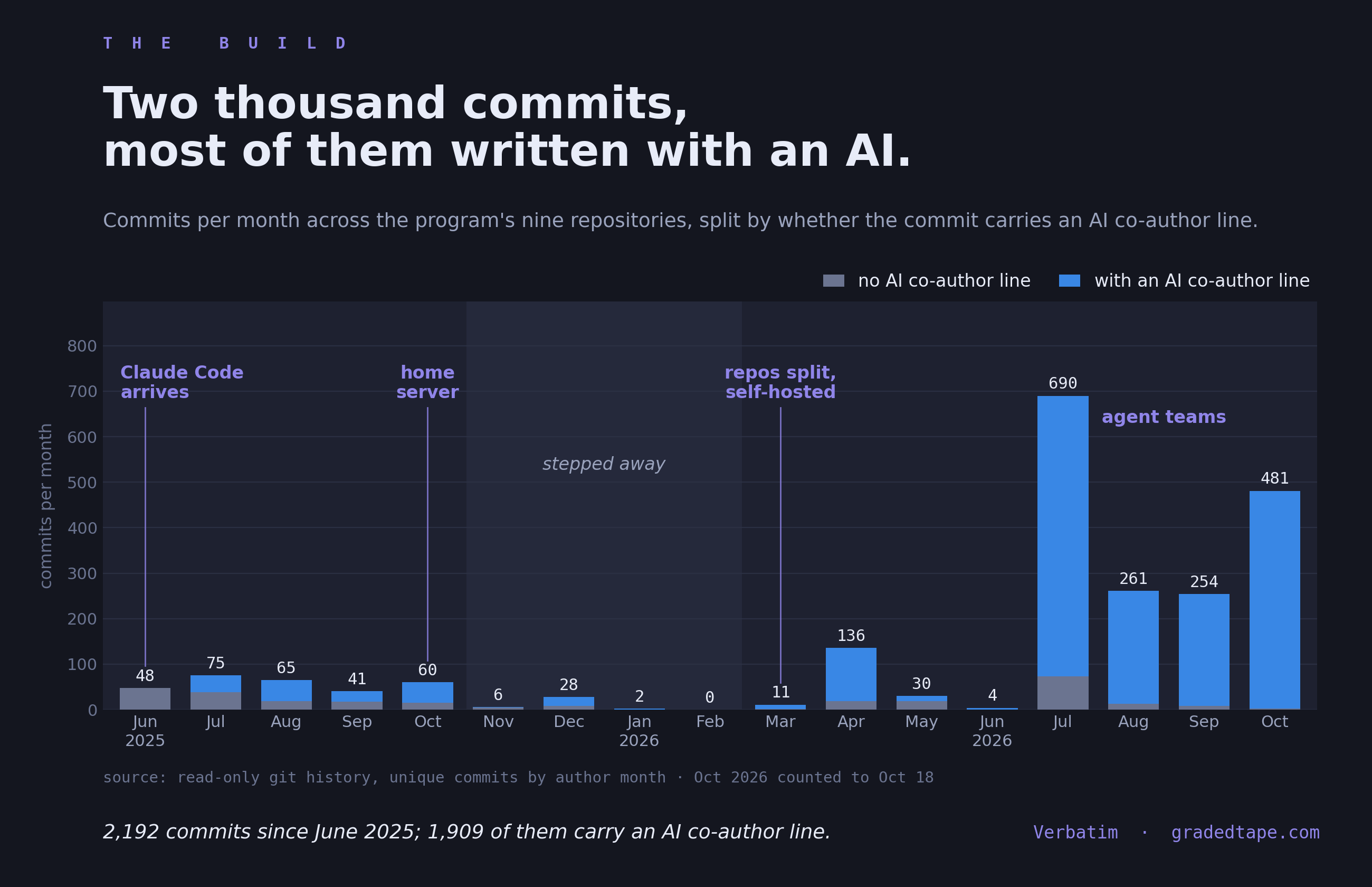
July 2026 is the tall bar I the bar cart, about 690 commits in a single month, more than the whole year before it combined (sort of, because I switch from Github and Codespaces to self-hosted git). That month I built a dashboard, started these letters, and wrote the code behind the public track-record sites. It is also when the agents began working in teams, with several at once on one job and separate agents set loose on the finished work to find its mistakes.
By August 2026 an audit could put fifteen reviewer agents over the code at the same time and come back with seventy findings. I don’t recommend it; you’ll eat your tokens real quick.
Today the program spans nine repositories and nearly 2,200 commits, more than 1,900 of them co-authored by Claude. Agents write the code and run the studies, a second and stronger model reviews what they produced, and I decide what gets built and which results count.
If you want to watch one person and a team of agents build this in the open, with every verdict published, subscribe and the next one arrives in your inbox.
What the tools closed
In 2022, the thing standing between my market ideas and a tested model was engineering I couldn’t do. The tools closed that gap, and the chart above shows how.
They only closed it after I was willing to start over many times and to learn the tooling for real: what a virtual environment is for, why version control matters, the benefits of containerization, and how to read the error the agent has just read. An agent that can write a thousand lines in a minute multiplies whatever understanding you bring to it, and I have watched it multiply a misunderstanding at the same speed. Most of the guardrails in this program, the audits, the locked-down home server, the reviewer model, are there to catch the second kind.
Where the money stands
None of this machinery has produced money yet. Through October 16, 2026, The Graded Tape reads -$1,877.13 at fixed paper sizes (thank goodness), and in October a pre-registered test of trading Lookout’s signals through the day lost money. The tools make it cheap to ask a question and just as cheap to fool yourself with the answer. The rules from the second letter are what stop me.
If you know someone building things with AI coding tools, or wondering whether they could, this one might be worth passing along.
Lab notebook, education and research purposes only. Not investment advice, not a solicitation; no advisory relationship is created by reading this. I trade a small account and describe my own process, errors included.