


Written in July 2026. Anything that has changed since then is marked with an October update.
If you are just arriving, the first arc of this notebook tested nine pre-registered ideas about Lookout, the intraday neural network model that this notebook is mostly about, so far. The tests ran on rented GPU time, cost me $423, and the verdicts were mostly unflattering: several noes, a couple of ties, one marginal call, and one clean win. The founding thesis of the whole project, the architectural belief I had organized two years of work around, was tested and lost, and I retired it.
Arc 1, “The Campaign,” covered what the rules decided. Arc 2, The Machinery,” covers how the rules work. Most of the ideas in arc 1 were retired. The rules that retired persist, and they are the reason the verdicts are believable.
I built each rule after I caught myself about to cheat the Scientific Method in a specific way. I tested it until it worked, then made it a standing part of the program, and it now applies to every result whether I like the result or not.
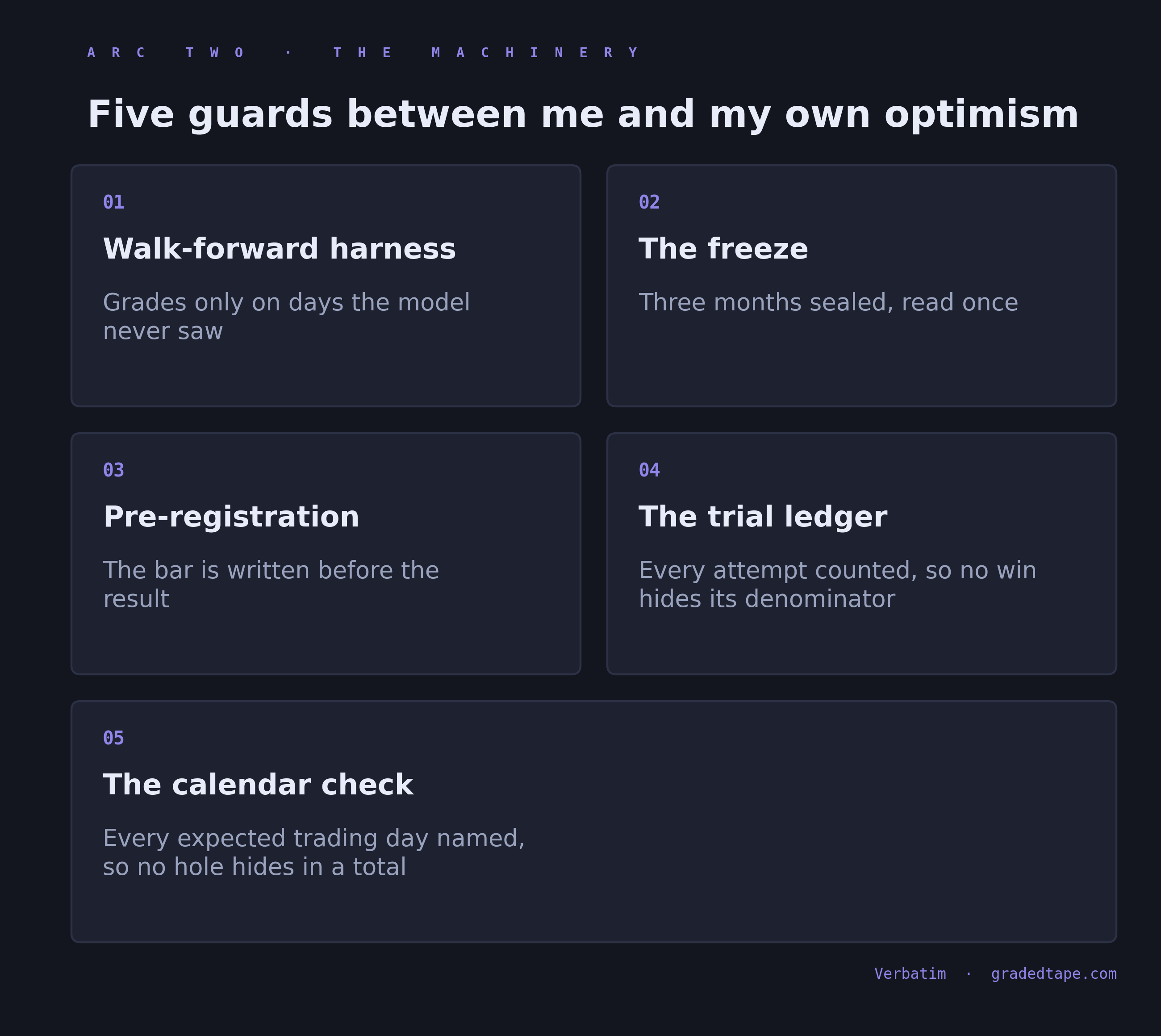
The next 5 letters describe the machinery, one piece each, in order:
Walk-forward evaluation, which grades a model only on days it has never seen, and why its score is almost always the lower one.
The freeze, three months of my own data I’m not allowed to consult, until one scheduled reading.
The parts of a pre-registration document, which you’re welcome to copy.
A failure I published on purpose.
Fifteen trading days my dataset lost, and the check that now looks for missing days every night.
None of this is my invention, but I’m applying it, stubbornly, to a small trading account.
Five letters on the checks that decide what I trade. Subscribe to read them as they come out.
The arc after this one covers the market behavior Lookout tries to catch. Later comes a live diary, where the program trades in public and the notebook gets a P&L column. Every number in that diary will depend on the checks in this arc, which is why they come first.
October update: the live diary has not started. I traded real money by hand, at half size, for a few days in August and then stopped; every bot since trades on a broker’s paper simulator. The P&L column that exists today is The Graded Tape, which grades every signal at fixed paper sizes. Through Oct 16, 2026, 60 trading days and 11,316 signals graded, it reads -$1,877.13.
How I built it
In the rest of The Machinery arc (the next 5 letters), this “How I built it,” section is for paid subscribers. Here it’s free, so you can see what it holds.
Every check in this arc came out of one Claude Code session that ran from July 7 to July 13, 2026, six days and 191 commits across five repositories. I didn’t write the code. I picked the bars, signed each design doc before anything ran, set the freeze date, and approved every dollar of rented GPU time.
When I went to bed, I left standing orders written as if-then rules. One of them told the agent to retry a failed nightly training job once, then skip it and put a banner on the morning report. The agent kept working overnight without making up policy at 3 a.m., and every rule that could flatter a result was in git before the result existed.
Try this: before your next overnight agent run, write five if-then orders for the failures you expect, and commit them first.
Lab notebook, education and research purposes only. Not investment advice, not a solicitation; no advisory relationship is created by reading this. I trade a small account and describe my own process, errors included.