


Written in July 2026. Anything that has changed since then is marked with an October update.
Over the course of five days in July I rented some powerful computing hardware and put nine of my best ideas for Lookout, my intraday neural network ensemble, through pre-registered trials. Each one got a hypothesis, a success bar and a budget, all written down before I was allowed to see a single result.
For most of the nine the bar was the same, to beat the incumbent model by at least +0.02 on a deliberately harsh precision statistic, on identical walk-forward test windows, with a bootstrapped confidence interval entirely clear of zero.
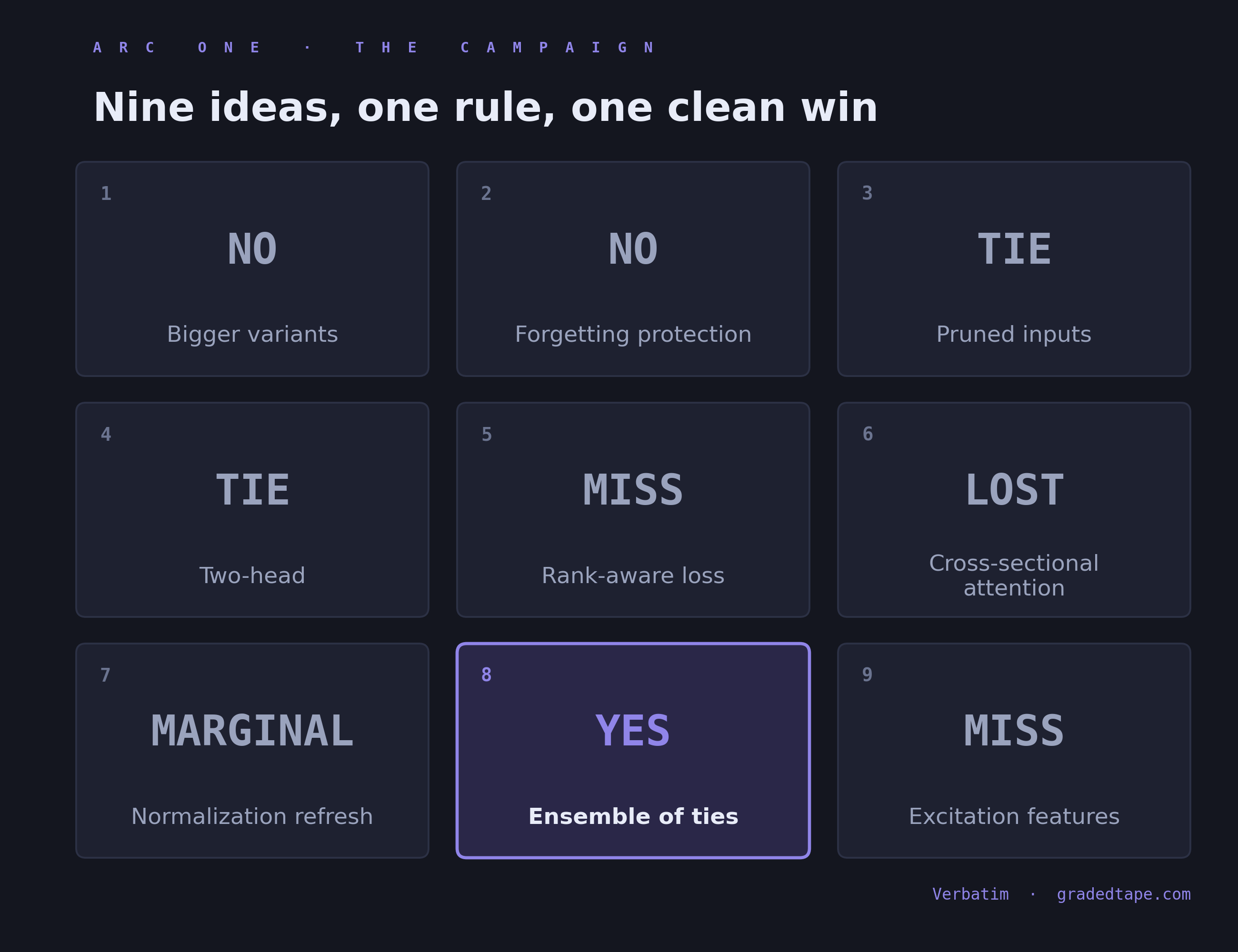
The next 6 letters describe the story in order:
The scoreboard.
My founding thesis loses.
A four-way tie, and what it told me.
The fifteen-dollar idea that beat the five-hundred-dollar ones.
The two simple baselines every model is checked against.
The stocks where my model is most precise.
Nine pre-registered verdicts, every number with its interval. Subscribe and follow the Campaign in the order it happened.
After this Campaign arc I’ll share the Machinery arc (why you can trust these results), the physics of how market moves cluster, the portfolio layer, and the live diary, where the whole program trades every day in public. The goal is trading with real money, and this campaign is why I felt confident about getting there.
October update: Lookout’s rankings held up, but in October a pre-registered test of trading them through the day lost money in its main configuration even before costs, and every variant lost after them. Later letters show how the program found that out and what I did next.
How I built it
Note: In the rest of The Campaign arc (the next 6 posts), the “How I built it” section sits below a Freewall line for subscribers who share their email. Here it’s free, so you can see what it holds. In The Machinery arc, the “How I built it” section will be reserved for paid subscribers.
The campaign started on my laptop, the day before I rented anything. I gave a Claude Code session a written plan and a free hand with the model’s code, with one condition. No powerful GPU machines get rented until this 32GB RAM laptop shows the model is worth renting for.
The agent wrote tests first, and the tests showed my model couldn’t reproduce its own April numbers. Four bugs did it:
The label looked one bar too early.
Short sequences were scored from padding.
An input clamp flattened some inputs into constants.
A misnamed key logged the headline score as zero.
With those fixed, I wrote down four go/no-go gates and ran 113 walk-forward windows on the laptop, which took 2.7 hours. It passed all four. My first rental plan was eight GPUs for about $300. The model turned out small enough that one card would sit mostly idle, so I rented one.
Over the six days of the campaign that one session made 108 commits and about 18,000 lines of code, roughly 5,000 of them tests.
Try this: before you rent anything, ask your assistant for tests that pin your metric on a case you can work out by hand, and run them against the code you already have.
Lab notebook, education and research purposes only. Not investment advice, not a solicitation; no advisory relationship is created by reading this. I trade a small account and describe my own process, errors included.