


Written in July 2026. Anything that has changed since then is marked with an October update.
Before I trust any score my model gets, I check what the dumbest credible alternative scores on the same test.
I hold Lookout, my intraday neural network ensemble, against two controls, each retrained inside the same walk-forward windows as the real thing. One is a plain logistic regression, which retrains in every window and never gets turned off, and the other is a set of gradient-boosted trees, run once as a full replay of 2023. Each control sees exactly the training history the deep model saw and gets graded on the same unseen days, so every comparison is like-for-like.
Every score below is P@1%FPR, which works like this:
The model ranks every stock it watches by its confidence that a large move is imminent.
Walk down that ranking, flagging names, until the false alarms among your flags add up to one percent of all the names that stayed quiet.
Stop there and ask what fraction of the flags were correct. That fraction is the score.
It’s a deliberately harsh grader, because it only looks at the top of the ranking under a tight false-alarm budget, which is where the trades come from.
The controls
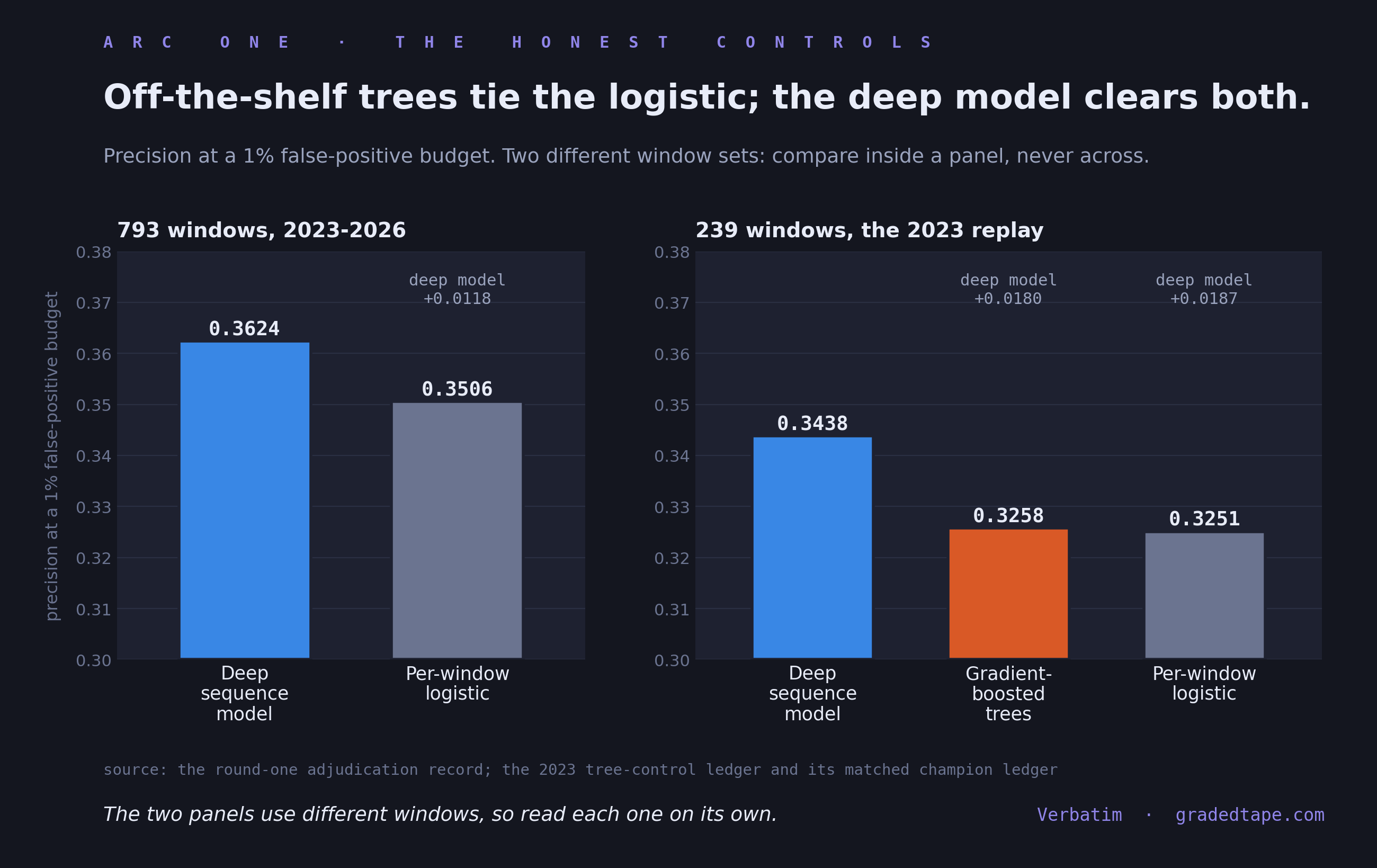
The logistic gets embarrassingly close to the deep model. And the gradient-boosted trees, the tool that wins most tabular-data competitions, land on the logistic’s score, well below my model’s.
What the trees told me
Trees and logistic regressions both look at a stock’s condition at one moment. My model looks at the sequence: how the last few hours unfolded, rather than only where things stand now. So when the trees (run here off the shelf, with fixed settings) land exactly on the logistic, and the sequence model clears them both, that narrows down where the edge comes from. Two different methods got the same score from that one-moment view, so there probably isn’t much more in it. Whatever extra the deep model knows most likely comes from the shape of the path.
That sorts future experiment ideas into two piles. Ideas that add information about the path have a chance, and ideas that only re-weight the one-moment view probably won’t help.
A point or two of precision
At the same one-percent false-alarm budget, the gap between Lookout and the logistic buys roughly one to two extra correct catches per hundred flags. That sounds small, and spread evenly across the market it would be. They aren’t. Positions get taken from the very top of the ranking, where those extra catches concentrate, and a percentage point of precision at the top compounds across hundreds of trading days into a difference that shows up in an account. For now, that’s worth running a much more complicated model.
October update: that compounding has not shown up yet. In October 2026 a pre-registered test of trading Lookout’s signals intraday, after costs, failed, and every variant tested lost money. The rankings still carry real signal (they rank what moves), but the signal has not yet turned into money at intraday horizons.
Every model here answers to a baseline, forever. Subscribe to watch what that does to a trading program.
A cheap side experiment
One afternoon went to a side experiment. Using a classical mathematical summary of price paths, no neural network anywhere at decision time, I recovered roughly 65 percent of the deep model’s edge over the logistic, running comfortably on a laptop CPU. For now it’s recorded and set aside, with a pre-registered path to promotion if the economics of my setup ever change.
October update: it took that path within weeks. The path-summary model was later added as the ensemble’s sixth member, under the same rules as every other idea.
The controls stay on
Every answer here cost almost nothing, because the controls retrain inside the same harness as the real model, window by window, and the logistic does it automatically and forever. If you run backtests, score a dumb baseline on the same days as your model. It’s cheap, and it tells you what your score is worth.
The logistic keeps running as the program trades in public, and I hope it beats the deep model someday. If it does, the harness catches it and I trade a simpler, cheaper machine. If it never does, my trust in the complicated one grows a little with each window.
October update: the logistic still votes in the ensemble every day, but since the nightly retrains began in July its score on its own is no longer logged, so the nightly comparison this paragraph describes is not running. The July replays above are where that comparison was made.
Lab notebook, education and research purposes only. Not investment advice, not a solicitation; no advisory relationship is created by reading this. I trade a small account and describe my own process, errors included.
Free subscribers get the build notes below, covering how the controls run alongside every training run, and the crash that kept the trees in their own process.